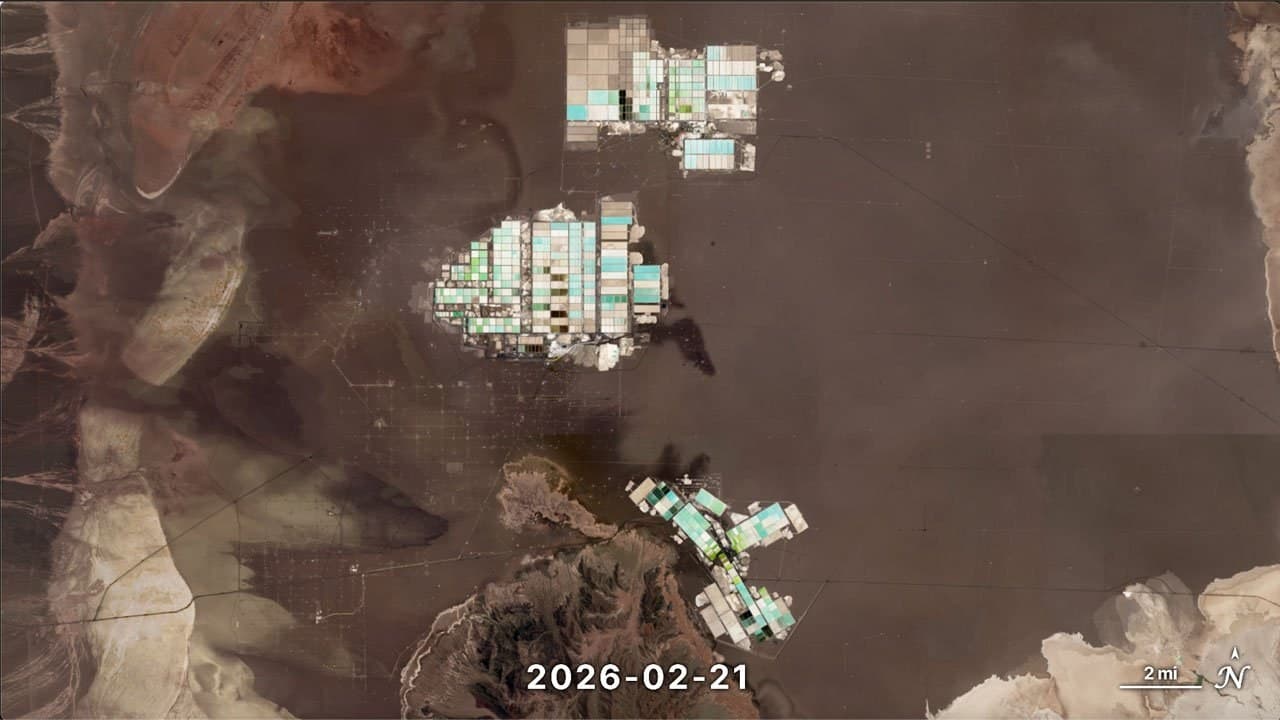
The driest desert on earth sits on the largest lithium brine reserve on earth: about 9.2 million tonnes of contained lithium under the Salar de Atacama, roughly 37% of the metal the world currently counts as reserves1. In December 2025 the deposit changed management. Codelco, the state copper company, completed a joint venture with SQM, the private producer that has pumped the salar's brine since the 1990s, holding 50% plus one share, with control of all lithium development in the Atacama through 20602.
The terms matter more than the headline. By Codelco's own account, the Chilean state will take about 70% of the operating margin on new production between 2025 and 2030, and 85% from 20312. That is not a nationalisation; SQM was not expropriated, and no asset was seized. It is something quieter and possibly more durable: the state renegotiated its share of a resource rent while leaving the operator in place, and it did so at the exact bottom of the most violent price cycle any battery material has yet produced.
Contained lithium in the Salar de Atacama brine, the world's largest lithium reserve, now majority-state-controlled through 2060.
Measure | Value |
|---|---|
Atacama contained lithium | 9.2 million tonnes, largest brine reserve |
Carbonate price, late 2022 peak | Above $81,000 a tonne |
Carbonate price, mid-2025 trough | About $8,259 a tonne in China |
Chile output, 2025 | 64,100 tonnes of lithium content |
State share of new-production margin | About 70% to 2030, 85% from 2031 |
Concession horizon | 2060 |
The crash the deal was signed into
Battery-grade lithium carbonate peaked above $81,000 a tonne in late 2022, at the top of the first electric-vehicle supply panic3. By February 2025 the North Asia price was under $10,000, and the Chinese spot market bottomed near $8,259 in June 2025: a decline of about 80% peak to trough3. The crash had ordinary causes moving at extraordinary speed. High prices pulled forward supply from Australia's hard rock, Chile's brine, and China's own lepidolite, while EV demand grew more slowly than the panic had assumed, and lithium turned out to be the thing it always was: not scarce, merely slow to bring online.
The whiplash rewrote every producer's politics. At $80,000 a tonne, lithium states dream in petrostate categories; at $9,000, the question inverts to who can survive the trough. Chile's answer was to lock in the state's take before the next peak rather than after it, which is what distinguishes the 2025 deal from the resource nationalism of commodity booms, usually announced at the top and regretted at the bottom. It also concentrated minds on the other side of the table: a producer facing a 2030 concession expiry in a single-digit price environment values certainty of tenure more than at any other moment in the cycle, which is a large part of why the negotiation that had stalled for years closed in this particular one.
How the deal is built
The structure follows the National Lithium Strategy President Gabriel Boric announced in April 2023: lithium develops through public-private ventures in which the state holds the majority, with Codelco as its instrument2. SQM keeps operating the ponds and plants it knows; its concession, which was due to expire in 2030, extends through 2060 inside the venture; the state's margin share steps up when the old concession would have ended. Each side traded its walk-away risk: SQM bought thirty years of tenure it could not otherwise count on, and the state bought majority control without a legal war or an operational learning curve.
The output plan is expansionary, which surprises people who hear 'state control' as 'restriction'. Chilean production rose about 10.1% to an estimated 64,100 tonnes of lithium content in 2025 and is forecast around 67,300 in 2026 as Atacama capacity expands4. Unlike Congo's cobalt quotas or Indonesia's ore cuts, Chile is not rationing supply to move price; it is maximising volume and taking its larger cut of whatever the price turns out to be. For the world's battery makers that makes Chile the friendly kind of resource nationalist: more supply, differently taxed.
Chile has run this play before, with the metal that built the country. Codelco itself is the child of the 1971 copper nationalisation, and half a century later it remains the world's largest copper producer and the treasury's workhorse. That history cuts both ways in the lithium debate: it proves a Chilean state enterprise can run a world-scale extractive business for decades, and it reminds investors that Chile is willing, under enough political pressure, to go further than a margin-sharing agreement. The joint venture's architecture, control without expropriation, reads as a promise that the second lesson stays historical.
The other precedent is SQM's own tenure, which is why the state wanted the pen. The company's Atacama rights ran through leases from CORFO, the state development agency, and the relationship spent much of the past decade in arbitration and renegotiation over royalties and quotas. A structure in which the state sits inside the venture, rather than outside it auditing invoices, is partly a governance fix: the owner of the resource and the operator of the ponds now read the same books.
What Chile is racing
The urgency underneath the strategy is market share, not geology. Chile was the world's largest lithium producer until 2017; Australia's mines passed it, and Argentina's brine projects, developed under a far more laissez-faire regime, are scaling fast next door. Brine from the Atacama is among the cheapest lithium on earth, but concessions, permitting, and water politics kept Chilean volumes nearly flat through the boom while rivals built. The 2060 horizon is meant to end that paralysis by settling the ownership question that froze investment for a decade.
Water is the constraint that does not negotiate. The salar's brine operations sit inside a watershed shared with indigenous Atacameno communities and a tourism economy, in a desert where evaporation ponds consume brine by the megalitre. Part of the joint venture's stated program is a transition toward direct lithium extraction technologies that return brine to the aquifer rather than evaporating it. If that transition works at scale it loosens the salar's real bottleneck; if it does not, the 2060 concession will spend its decades negotiating with hydrology.
Direct lithium extraction is a family of technologies, adsorption, ion exchange, membranes, that pull lithium selectively out of brine and return the depleted water underground instead of evaporating it for a year and a half in open ponds. The attractions are real: recovery rates that can roughly double the ponds' share of the lithium, weeks of processing instead of months, and a far smaller hydrological footprint. What is missing is proof at scale. DLE runs commercially in Argentina and in Chinese plants working on different brine chemistries, but nothing close to the Atacama's volumes, and the leading approaches consume energy and fresh water in ways that matter in a desert. Until a full-scale line runs on the salar, DLE is a plan supported by pilot data, not a proven replacement.
Demand, meanwhile, is not the doubtful half of the equation. Electric vehicles keep growing through every price cycle of their inputs, and grid storage has emerged as a second lithium market with its own economics: batteries paired with solar are being installed on every continent because the pair now undercuts alternatives on cost. The crash of 2023-25 was a supply story, not a demand story. The tonnage the world will want in 2035 exceeds anything the current producers ship today, which is exactly why the ownership of the cheapest large deposit was worth a constitutional-scale negotiation to settle.
The triangle and the substitutes
Chile's position compounds with its neighbours'. The lithium triangle where Chile, Argentina, and Bolivia meet holds around 54% of world reserves1, and the three states run a natural experiment in extraction regimes: Argentina's open federalism, Chile's state-majority ventures, Bolivia's fully state-owned model that has yet to produce commercial volumes. The three differ in more than ideology, in permitting speed, fiscal terms, infrastructure, and operating experience, so the comparison measures whole systems rather than ownership models alone. The score so far: Argentina has grown fastest from a standing start, Chile earns the most per tonne, and Bolivia has yet to convert its reserves into shipments. The Chilean bet is that its middle path captures the rent without strangling the volume.
The metal itself faces no cliff. USGS counts about 37 million tonnes of lithium in world reserves and far more in resources, with new brine and clay provinces from Arkansas to the Rhine under evaluation1. Nothing about lithium's crust abundance guarantees Chilean pricing power the way phosphate guarantees Morocco's. What Chile owns is cost position and head start, wasting assets both, which is the real argument for the strategy's urgency: rent not collected in the 2030s may not be there in the 2050s.
What to watch
The price first: forecasts of the surplus flipping to deficit cluster around 2026-27, and the state's 70% margin share is worth 70% of whatever that recovery delivers3. Then the volume line: whether Chilean output actually reaches the expanded targets, because the strategy's legitimacy at home rests on cheques, not principles. And the Argentine comparison, because if the unmanaged model next door keeps outgrowing the managed one, the 2060 architecture will face its critics with the border as the control group.
And one engineering date: the first commercial-scale direct lithium extraction line on the salar. Every party to the venture has reason to want it, the state for the water politics, the operator for the recovery rates, the communities for the aquifer, and nobody has yet run DLE at Atacama scale anywhere. The 2060 concession is, among other things, a thirty-five-year bet that the chemistry industry can retire the evaporation pond before the desert retires the concession. The deposit will outlast everyone involved; whether the water does is the question the venture has thirty-five years to answer.
Fastmarkets, Negotiations for world's largest lithium reserve in brine can be win-win: 9.2 million tonnes of contained lithium in the Salar de Atacama, about 37% of world reserves; the lithium triangle around 54%. USGS puts 2025 world reserves at about 37 million tonnes.
Mining Technology, Salar de Atacama expansion set to lift Chile lithium output in 2026 and Mining Digital, Why Codelco and SQM are mining Chilean lithium: joint venture completed December 2025; Codelco 50% plus one share; control of Atacama lithium through 2060; state share of operating margin about 70% for 2025-2030 and 85% from 2031, per Codelco; framework from the April 2023 National Lithium Strategy.
Carbon Credits, Lithium prices crash below $10K and Investing News Network, Lithium market 2025: battery-grade carbonate above $81,000 a tonne in late 2022; under $10,000 CIF North Asia by February 2025; Chinese spot near $8,259 in June 2025; surplus-to-deficit forecasts around 2026-27.
Mining Technology, Salar de Atacama expansion set to lift Chile lithium output in 2026: Chilean production up an estimated 10.1% to 64,100 tonnes in 2025, forecast 67,300 tonnes in 2026.