On 5 December 2022 the National Ignition Facility in California put 2.05 megajoules of laser light onto a peppercorn of frozen hydrogen and got 3.15 megajoules of fusion energy back: the first controlled fusion reaction in history to produce more energy than was delivered to the fuel1. The line was real, physics has a name for it, ignition, and it had been chased for seventy years. What has happened since matters more for whether the line leads anywhere: NIF has repeated ignition eight times as of 2025, and an April 2025 shot turned 2.08 megajoules of laser light into 8.6 megajoules of yield, a gain above four1.
That is the headline. The caveat: the laser that delivered those 2 megajoules drew hundreds of megajoules from the wall, the facility fires about once a day, and a power plant needs to fire many times a second with cheap targets and a way to catch the heat. Ignition proved the fuel will burn. Everything between a burning peppercorn and a turbine remains engineering nobody has done, which is why the interesting story in 2026 is no longer the physics; it is who is spending what to do that engineering, and on which clocks.
NIF's April 2025 result: 8.6 MJ of fusion yield from 2.08 MJ of laser energy on target, the best of eight ignitions since December 2022.
What ignition is, precisely
The definitional care matters because fusion's history is littered with 'breakthroughs' that were accounting choices. NIF's gain is measured at the target: energy out of the burning fuel against laser energy delivered onto it. By that physics definition, ignition is real, repeatable, and improving; the plasma heats itself faster than it loses heat, which is the phenomenon that powers stars and had never before been produced under control. By the wall-plug definition a utility cares about, every fusion machine on earth remains a net consumer of electricity by orders of magnitude. Both statements are true. Journalism that collapses them, in either direction, is how the public ends up alternately overpromised and cynical about a field that is, in fact, moving.
The ladder from here has four rungs, each with its own vocabulary. Scientific gain, NIF's achievement, compares fusion energy out with beam energy delivered onto the fuel. Facility gain would compare it with everything the building draws, a bar no machine approaches. Net electricity requires capturing the heat and running a turbine, with the plant's own consumption subtracted. And commercial fusion requires doing all of that at a cost someone will sign a contract for. Private roadmaps use 'net energy' for different rungs, SPARC's Q above one is plasma gain, not wall-plug electricity, so reading any fusion announcement starts with asking which rung it means.
The eight repetitions carry as much information as the first shot. Ignition at NIF is sensitive to capsule defects measured in nanometres, and the campaign's early criticism was that December 2022 might be a lucky capsule. The subsequent record, higher yields from similar inputs, gain climbing from 1.5 to above 4, says the operating regime is understood rather than stumbled upon1. Repeatability is what converts a miracle into a baseline, and baselines are what engineering programs are built on.
Three clocks, running at different speeds
Fusion now runs on three clocks. The government-science clock, NIF and its peers, advances steadily and was never designed to make electricity; NIF is a weapons-stewardship facility whose ignition campaign doubles as the field's proof of principle. The international-megaproject clock, ITER, moves slowest: its 2024 rebaselining pushed the start of research operations to 2034 and full deuterium-tritium work to 2039, adding around 5 billion euros to a budget already the largest in experimental science2. ITER will still answer questions nothing else can, at burning-plasma scale, but nobody now pretends it sits on the path to first commercial power.
The third clock is private, and it is the one that changed. The Fusion Industry Association's latest census counts $14.24 billion in cumulative funding to fusion companies, with a record $4.48 billion raised in the most recent year alone, after $2.64 billion the year before3. The backers have shifted from venture funds making option bets to strategic money with load to serve: the hyperscalers whose data-centre demand reshapes every energy story have signed the first meaningful fusion power purchase agreements, paying today for electrons promised in the 2030s.
The machine to watch
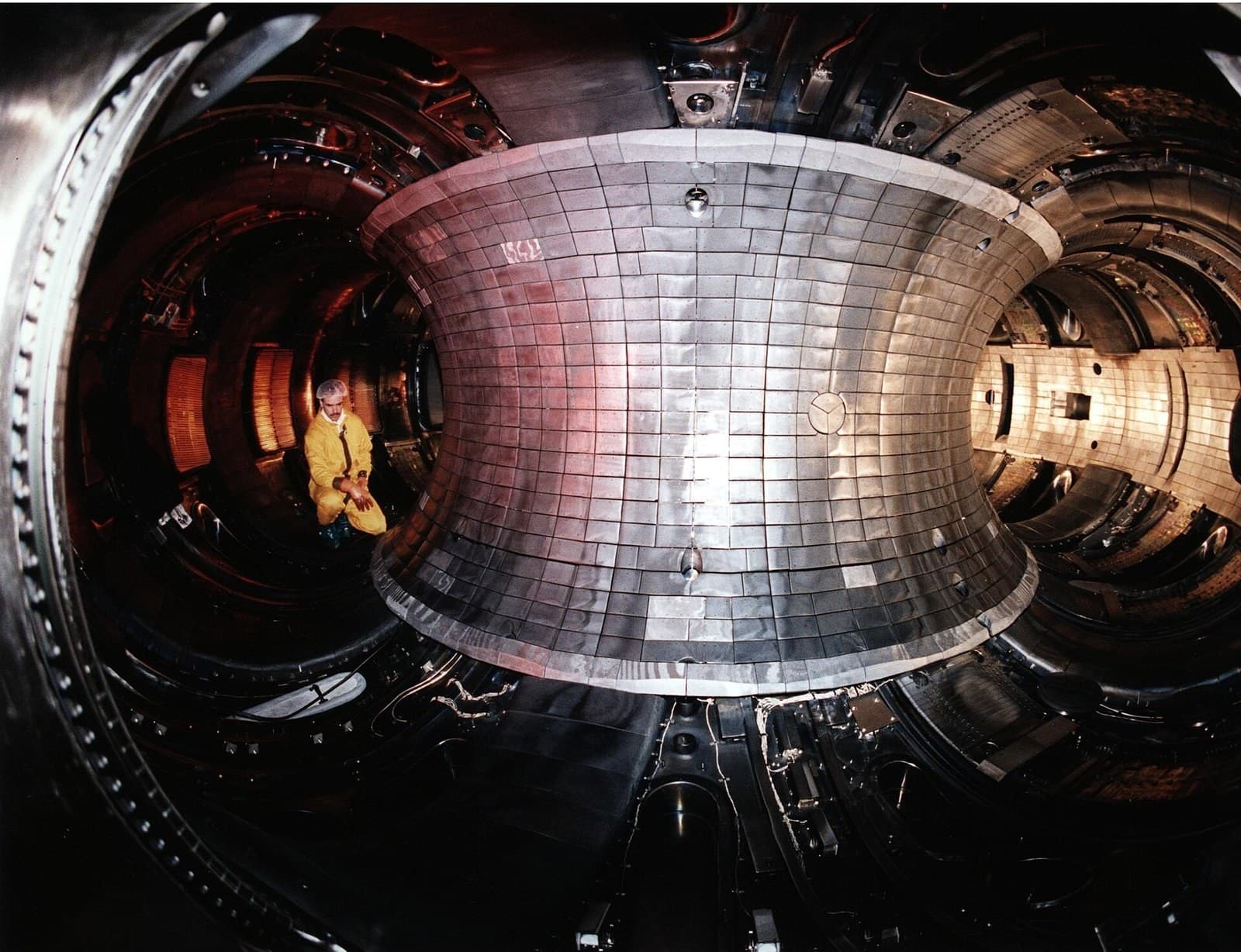
Among the private ventures, Commonwealth Fusion Systems carries the nearest-term falsifiable claim. Its SPARC tokamak outside Boston, built around the high-temperature superconducting magnets that are the company's actual invention, is in assembly, with the first major magnet installed and operations pointed at a demonstration of net fusion energy, Q above one, targeted for 20274. Behind it the company has booked over a billion dollars of power offtake for ARC, the plant it intends in Virginia in the early 2030s, and drawn Google and Nvidia into compute and simulation partnerships4. None of this guarantees the physics cooperates. All of it means a private company has put a date on the field's central claim, close enough to check.
The rest of the field diversifies the bet: laser-inertial startups riding NIF's proof directly, magnetized-target and field-reversed schemes promising cheaper machines, stellarators trading plasma stability for magnet complexity, and a Chinese state program building tokamak infrastructure at the pace China builds everything, with government fusion spending that US analysts now rank first or second in the world3. Portfolio logic, not any single design, is the rational case for the sector.
Item | Status |
|---|---|
NIF ignitions since Dec 2022 | Eight; best gain 4.13 (8.6 MJ from 2.08 MJ) |
ITER research operations | 2034; deuterium-tritium from 2039 |
Private funding, cumulative | $14.24 billion; record $4.48 billion in the latest year |
SPARC net-energy target | 2027 |
First planned commercial plant | ARC, Virginia, early 2030s |
Grid electrons delivered from fusion | Zero |
What has to become boring
Between ignition and a grid connection stand problems with no Nobel in any of them. Materials that survive years of 14-MeV neutron flux. Breeding tritium from lithium blankets at better than break-even, for a fuel that essentially does not exist in nature and whose civilian inventory is measured in tens of kilograms. Target factories, for the inertial path, that stamp out precision fuel capsules for cents rather than craftsman-hours. Heat capture, maintenance robots, licensing regimes. Each is tractable; none is done; and their aggregate is why sober roadmaps put first commercial fusion power in the 2030s at the earliest and why every earlier date is best read as a fundraising document until a Q>1 machine actually runs.
The competitive context has also moved, which fusion's advocates discuss less than they should. The firming problem fusion was supposed to solve someday is being priced down now by batteries falling 45% a year and by a nuclear-fission revival with working reactors. Fusion's eventual market is real, firm, dense, fuel-secure power, but the bar it must clear on cost rises every year its rivals spend on their own learning curves. The race is not against scepticism. It is against everything else's progress.
Why do the hyperscalers pay now for 2030s electrons? Partly because the sums are small against their capex, an option premium rather than a procurement; partly because a fusion PPA buys regulatory goodwill and recruiting shine; and partly because the buyers have concluded, from inside the largest energy-demand shock of the decade, that firm clean power in the 2030s will be scarce enough to be worth reserving in advance from every plausible source at once. The same logic funds their nuclear restarts and their geothermal pilots. Fusion has been promoted from miracle to line item in a diversified procurement strategy, which is less romantic and far more bankable.
The geopolitics have quietly inverted, too. Fusion's fuel inputs, deuterium from water, lithium for tritium breeding, are abundant and widely held, which is exactly the opposite of the century's other supply chains, from cobalt to gallium. A world that ran meaningfully on fusion would be a world with radically fewer energy chokepoints, which is why state funders frame it as security spending, and why China's program builds at industrial pace without waiting for the economics to close. Whoever industrialises the technology first exports the machines; nobody gets to export the fuel leverage. That alone distinguishes it from every other energy race running.
What to watch
A note on the failure mode worth fearing: not fraud, but drift. Decade-scale ventures funded on milestones learn to redefine milestones, and fusion's history holds several cautionary generations of moving goalposts. The discipline this round has that earlier ones lacked is falsifiable near-term dates staked by private actors with their own capital at risk, and a press corps that has finally learned the difference between target gain and wall-plug gain.
Four dates and numbers, in order of information value. SPARC's first full-field plasma and its Q number, because 2027 is the field's first near-term, privately-staked, checkable claim4. NIF's yield trajectory, because gain above ten from a facility never built for it would keep resetting the physics ceiling1. The FIA's next funding total, because the first down year will test whether strategic money behaves better than venture money in a field of decade-long feedback loops3. And tritium inventory announcements from ITER and the national labs, because the least glamorous number in the field is the one every deuterium-tritium roadmap quietly depends on. Fusion stopped being impossible in 2022. It has not yet started being inevitable, and the difference is a decade of engineering that has, at last, been funded like it matters. This page will keep the scoreboard, and the scoreboard, not the press releases, will say when the oldest promise in energy changes tense.
Lawrence Livermore National Laboratory, Achieving fusion ignition and The future of ignition: 2.05 MJ in, 3.15 MJ out on 5 December 2022; eight ignitions by mid-2025; 8.6 MJ from 2.08 MJ on 7 April 2025, gain 4.13.
ITER Organization, Updated baseline, and Physics World, ITER hit by decade-long delay and 5 billion euro price hike: start of research operations 2034; deuterium-tritium phase from 2039.
Fusion Industry Association, Fusion industry attracts record annual funding of $4.48bn, raising total to $14.24bn and the 2025 global industry report ($2.64 billion in the year to July 2025); Neutron Bytes, China and US are global leaders in fusion funding.
Commonwealth Fusion Systems, SPARC; TechCrunch, CFS books a $1B power deal (September 2025) and CFS installs reactor magnet, lands deal with Nvidia (January 2026): net-energy demonstration targeted 2027; ARC planned for Virginia in the early 2030s.