Singapore imports its crude oil, its natural gas, most of its food, and at times its sand and its fresh water. In 2025 it sold 56.77 million tonnes of marine fuel to the world's ships, 3.4% more than the year before and more than the next five bunkering ports combined15. It has held the top position for decades, and the gap is not closing: the second port, Rotterdam, sold 9.8 million tonnes.
The denominator makes the number clearer. The International Maritime Organization's fuel data for 2024 puts the consumption of international shipping, counting vessels over 5,000 gross tonnes, at 242.4 million tonnes3. Singapore's sales that year were 54.92 million tonnes2: nearly 23% of the total, more than one tonne in five, sold from a city-state with no oil under it.
Marine fuel sold in the Port of Singapore in 2025, a record and an increase of 3.4% on 2024.
None of that position was given, which makes it worth tracing how it was built. Congo has cobalt, Morocco has phosphate, Chile has lithium; Singapore has a location and what seven decades of policy stacked on top of it. The stack has four layers: a strait, a refining industry, a measurement regime, and a port that is being rebuilt before the old one is full.
What bunkering is, and who else does it
Bunker fuel is the heavy fuel ships buy in port. A ship fuels where the price is low and the detour is short, which is why the trade concentrates: a port that sits on a route ships already use can sell fuel without costing the buyer a single extra mile. The concentration is extreme.
Port | 2025 sales | Change on 2024 |
|---|---|---|
Singapore | 56.77 million tonnes | +3.4% |
Rotterdam | 9.82 million tonnes | +0.03% |
Zhoushan | 8.03 million tonnes | +10.6% |
Fujairah | 7.40 million cubic metres | -2.8% |
Fujairah reports volume rather than mass, roughly 7.25 million tonnes at typical densities5. The order changed in 2025: Zhoushan, the bunkering arm of the Ningbo-Zhoushan port complex in Zhejiang, grew 10.6% and moved past Fujairah into third place, with Chinese refining capacity behind it and Chinese export rebates on marine fuel underneath the price. Rotterdam, second for years, was flat. Nobody is within a factor of five of Singapore.
A raw material called position
The Strait of Malacca is the shortest sea route between the Indian Ocean and the Pacific, which makes it the shortest route between the factories of East Asia and everyone west of them. More than 102,500 ships passed through it in 2025, according to Malaysia's Marine Department, up from 94,300 the year before6. In the first half of 2025 the strait carried around 23.2 million barrels of oil a day, 29% of all seaborne oil trade, on the US Energy Information Administration's count6.
Singapore sits at the strait's eastern mouth, where the deep-water channel passes closest to shore. A ship transiting from the Gulf to Shanghai, or from Rotterdam to Yokohama, passes the anchorage whether it buys anything or not. The fuel sale is an errand run at a place the ship already is. That is the whole geographic advantage, and it explains the port's founding but not its margin over rivals who share the same water: Port Klang and Tanjung Pelepas sit on the same strait and sell a fraction of the fuel. The rest of the answer is on land.
What the state added
First, refining. ExxonMobil's Singapore refinery, split between Jurong and Pulau Ayer Chawan on Jurong Island, runs about 592,000 barrels a day and is the company's largest integrated refining and chemicals site anywhere7. The other pillar, the Bukom island refinery Shell operated for decades, changed hands in April 2025: a joint venture of Indonesia's Chandra Asri (80%) and Glencore (20%), trading as Aster, bought it with its 237,000 barrels a day of capacity and has announced plans to lift that to 307,0008. Between them, and with the storage terminals around them, the port manufactures much of what it sells. The fuel is made at the anchorage rather than shipped to it, and Asian refined products trade against price assessments taken in Singapore, so the port is also where the price is discovered.
Second, measurement. Marine fuel is sold by mass, delivered by hose, and was historically measured by dipping tanks with a sounding tape, a procedure with room in it for every variety of short delivery. From 1 January 2017 Singapore became the first port in the world to require coriolis mass flow meters on residual fuel deliveries, extending the requirement to distillates later; the authority paid a S$80,000 subsidy per bunker tanker to fit them9. The meter settles the oldest dispute in the trade before it starts. A buyer who cannot afford a quantity dispute in a foreign port pays for that certainty, and the regulator polices it: suppliers caught short-delivering lose their licences, and the licence list is short and public.
Third, the state treats the port as core infrastructure rather than as a revenue source. Bunkering is licensed but not taxed into the price; the competition among roughly forty licensed suppliers keeps Singapore's delivered price close to the cargo price. The business model is volume and adjacency: the ship that fuels also stores, repairs, changes crew, and clears paperwork in the same call.
The fuel is changing under the port
The 2025 record hides a composition shift. Very-low-sulphur fuel oil, the default since the global sulphur cap of 2020, fell 2.5% to 28.83 million tonnes. High-sulphur fuel oil rose 7.8% to 21.73 million tonnes, bought by the growing share of ships fitted with exhaust scrubbers that are allowed to burn it4. The cheap dirty fuel is gaining share inside the record, not losing it.
The alternative fuels are small and growing quickly. Sales of biofuel blends reached 1.36 million tonnes in 2025, up more than 54% in a year; liquefied natural gas reached 571,400 tonnes, up 24%. Together the alternatives came to 1.95 million tonnes against 1.35 million in 20244: 3.4% of the port's sales, after years of rounding to zero. The port's regulator licenses the new fuels on the same terms as the old ones, which is the practical meaning of its stated position: whatever the world's fleet burns next, it should plan to buy it here.
The boxes tell the same story
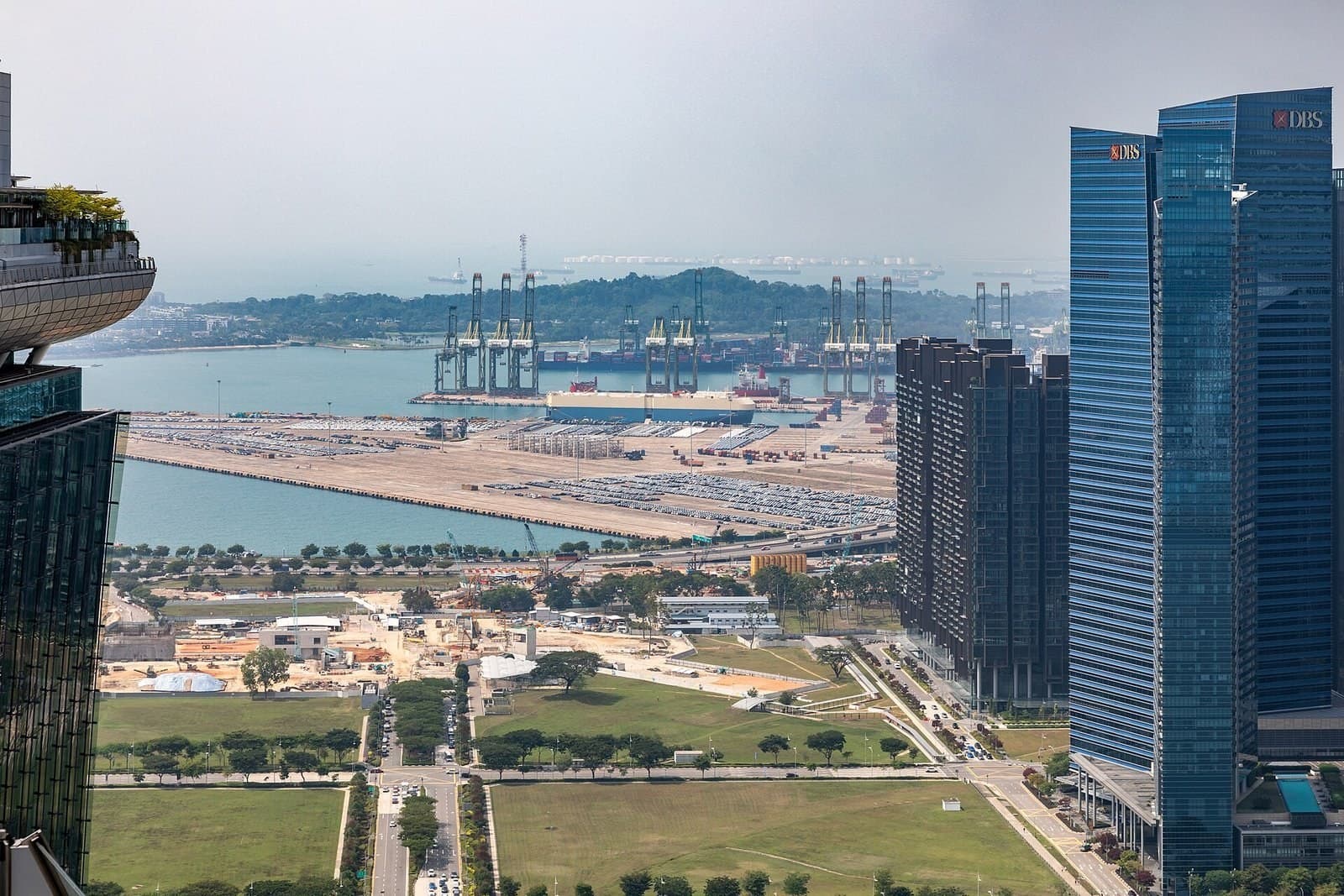
The fuel trade has a twin. Singapore handled 44.66 million twenty-foot container units in 2025, up 8.6% and also a record1; about 90% of its container traffic is transshipment, boxes that change ships without entering the country2. Total vessel arrivals reached 3.22 billion gross tonnes. The ship registry passed 137 million gross tonnes, the world's fourth largest. Every one of those numbers is a form of the same sale: a stop on a route somebody else's cargo was taking anyway.
The scale of the bet on continuity is visible at Tuas, on the island's western tip, where the entire container operation is being rebuilt as one automated port. Tuas opened in September 2022 and had moved its ten millionth container by February 2025. Its first phase alone is built for 20 million units a year when fully operational in 2027; at completion in the 2040s the plan is 65 million10, half again the record just set. The city terminals it replaces return to the waterfront as land, which is the other thing a port is worth in a country of 730 square kilometres.
What would unwind it
Singapore's position is a flow, not a stock. A resource exporter that loses a customer still owns the deposit; a port that loses a route owns an anchorage with nobody in it. The same feature is both the model's strength and its exposure.
The recent windfalls cut both ways. Global bunker demand rose 4% in 2024 largely because Red Sea attacks pushed traffic around the Cape of Good Hope, and longer routes burn more fuel3. A reopened Red Sea would hand some of that back. The structural risks are slower: proposals to bypass the strait recur every decade, from a canal across the Kra isthmus of Thailand to overland rail and pipelines through Malaysia and Myanmar, and none has yet been built at scale. Zhoushan's growth shows what a rival with state backing and domestic refining can do, though it serves ships calling at Chinese ports rather than intercepting transit traffic. And the long decarbonisation of shipping would shrink the tonnage of fuel there is to sell even if every ship kept the same route.
Against those, the port holds the advantages that are slow to copy: the refineries at the anchorage, the measurement regime buyers trust, the adjacent services, and a government that prices the whole complex to keep the traffic rather than to tax it. The response to uncertain forecasts has been to build ahead of them. Tuas Phase 2's first berths enter service in 202810.
Maritime and Port Authority of Singapore, Singapore Posts Record Port Performance in 2025 (January 2026). Bunker sales 56.77 million tonnes, up 3.4%; container throughput 44.66 million TEUs, up 8.6%; vessel arrivals 3.22 billion GT; Singapore Registry of Ships 137.46 million GT.
Maritime and Port Authority of Singapore, Strong Growth Momentum for Maritime Singapore (January 2025). Bunker sales of 54.92 million tonnes in 2024; 41.12 million TEUs handled, of which about 90% transshipment.
EnergyComment, Shipping Fuels 2025: Bunker Sales and Decarbonisation, reporting IMO fuel data: 242.4 million tonnes consumed by international shipping (vessels over 5,000 GT) in 2024, up 4.0%, with Red Sea diversions the main driver; Singapore handled nearly 23% of global bunker sales.
Ship & Bunker, Singapore Annual Bunker Sales Reach New Record High in 2025. VLSFO 28.83 million tonnes (down 2.5%); HSFO 21.73 million tonnes (up 7.8%); biofuel blends 1.36 million tonnes (up more than 54%); LNG 571,400 tonnes (up 24%); alternative fuels 1.95 million tonnes against 1.35 million in 2024.
Bunker Index, Zhoushan becomes world's third-largest bunker port. Rotterdam 9.823 million tonnes (up 0.03%); Zhoushan 8.03 million tonnes (up 10.6%); Fujairah 7.40 million cubic metres (down 2.8%), roughly 7.25 million tonnes.
US Energy Information Administration, The Strait of Malacca, a key oil trade chokepoint; transit counts from Malaysia's Marine Department, reported by Malay Mail (April 2026): 102,500 transits in 2025; about 23.2 million barrels of oil a day in the first half of 2025, 29% of seaborne oil trade.
ExxonMobil, Our operations in Singapore. Crude distillation capacity of about 592,000 barrels a day across the Jurong and Pulau Ayer Chawan sites; the company's largest integrated manufacturing site.
Oil & Gas Journal, Shell concludes sale of Singapore downstream refining, chemicals park (April 2025). Sale of the 237,000 b/d Bukom and Jurong Island complex to Aster Chemicals and Energy, the Chandra Asri (80%) and Glencore (20%) joint venture, with announced plans to lift capacity to 307,000 b/d.
Maritime and Port Authority of Singapore, Port of Singapore is First in the World to Mandate the Adoption of Mass Flow Metering System for Bunkering; incentive of S$80,000 per bunker tanker reported by Ship & Bunker.
Maritime and Port Authority of Singapore, Port of the Future; capacity and phasing also in Container News: opened September 2022; ten million TEUs handled by February 2025; Phase 1 built for 20 million TEUs a year, fully operational in 2027; first Phase 2 berths in service from 2028; 65 million TEUs at completion in the 2040s.