The CHIPS and Science Act of 2022 was a $52.7 billion answer to an extreme concentration: the most advanced chips came from one company on one island, and America's own share of leading-edge manufacturing was zero. Three years on, the question 'did it work' has stopped being rhetorical and started being auditable. By January 2025 the Commerce Department had awarded $30.7 billion in grants and $5.5 billion in loans to 19 companies across 40 fab projects1, and companies had announced more than 80 projects worth nearly $450 billion in private investment across 25 states2.
Concrete became silicon on schedule at exactly one site. TSMC's first Arizona fab entered volume production on its 4-nanometre process in early 2025, with yields its customers accept as equivalent to Taiwan's1. Apple and AMD processors made in Phoenix are in devices now, and the company has since grown its Arizona commitment into a $165 billion, multi-fab programme. The rest of the scoreboard is mixed, which is what a scoreboard is for: some of the delays are the ordinary physics of the world's hardest construction, and some are the demand signal telling the truth the subsidies talked over.
America's share of advanced logic manufacturing (below 10nm), 2022 against the projection for 2032.
What the law is, mechanically
The headline $52.7 billion divides into parts that behave differently. About $39 billion funds manufacturing incentives, the grants and loans the tracker below audits; $11 billion funds R&D, including a National Semiconductor Technology Centre; the rest scatters across workforce and defence programs. Alongside the appropriations sits the piece that may matter most and audits worst: a 25% investment tax credit on fab construction and equipment, uncapped, which scales automatically with every private dollar the announcements bring1. The grants made the headlines; the credit quietly co-finances the whole $450 billion pipeline.
The design also stapled conditions to the money: recipients accept restrictions on expanding advanced capacity in China for a decade, guardrails that turn a subsidy into an instrument of export-control policy. Every major recipient runs China operations of some kind, so every award was also a forced choice of which market to grow in. The law's full name is industrial policy, but its middle name is containment.
The awards, project by project
Company | Award | Status |
|---|---|---|
Intel | Up to $8.5 billion, later restructured | Arizona and Oregon advancing; Ohio fab delayed |
TSMC | Up to $6.6 billion | Fab 1 producing 4nm; fabs 2 and 3 building |
Samsung | $4.7 billion, cut from $6.4 billion | Taylor, Texas fab pushed toward 2026 |
Micron | Up to $6.1 billion plus $275 million | Idaho advancing; first New York fab delayed 2028 to 2030 |
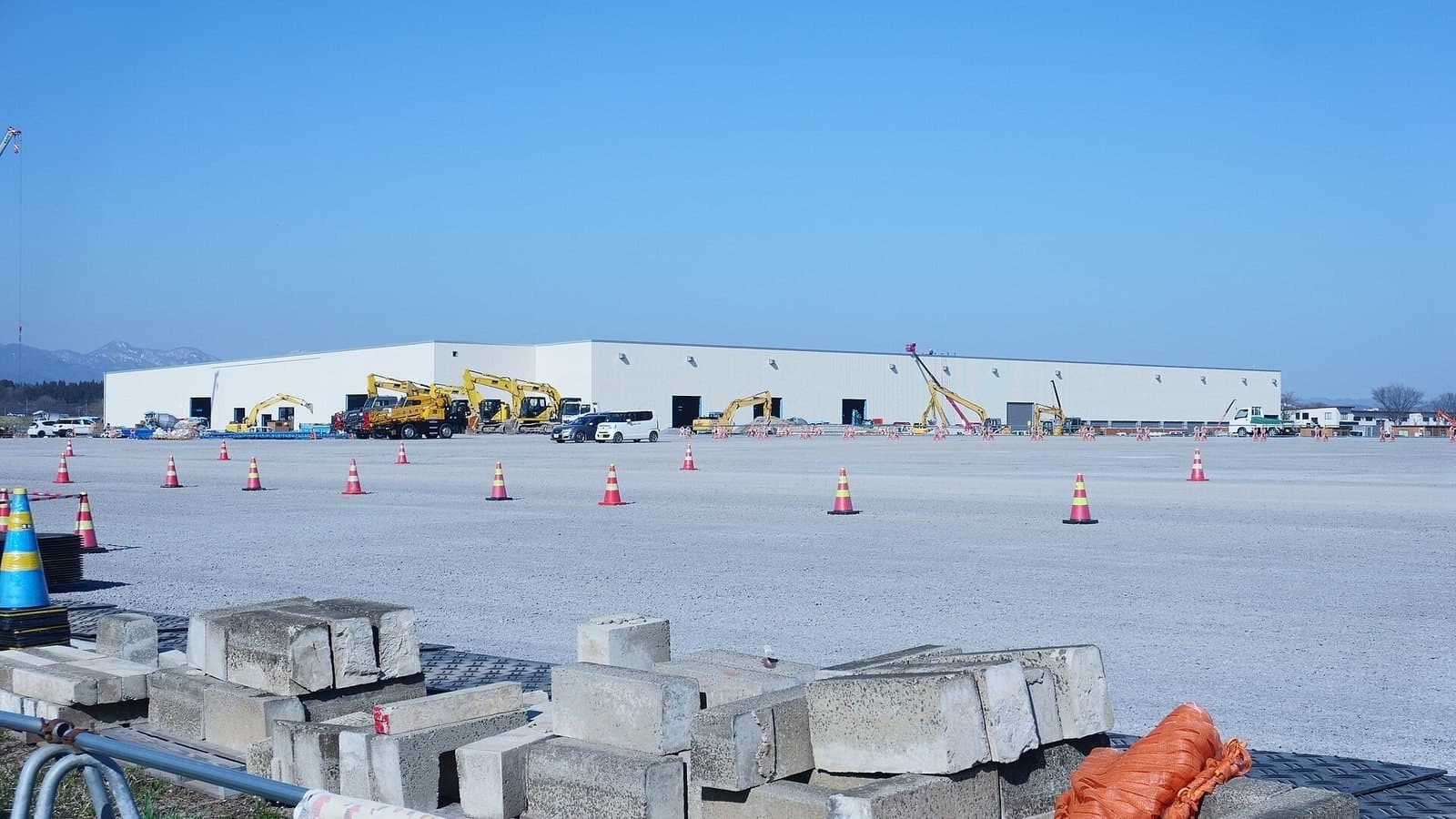
The delays cluster where the anchor customer is weakest. Micron pushed the first of its planned New York fabs from 2028 to the third quarter of 20301. Intel delayed its New Albany, Ohio complex, announced in 2022 as the future largest chip plant on earth, into the next decade1. Samsung's Taylor fab finished its shell years before its tools, waiting for customers worth ramping for. A fab is the most expensive building humanity makes, and nobody equips one until the order book exists; subsidies changed where shells got built faster than they changed who needs the wafers.
The bet that became a shareholding
The law's strangest turn came in August 2025. Intel, the only American company attempting leading-edge logic on American soil, was struggling: foundry losses, a fired CEO, a delayed process roadmap. Rather than pay out the remainder of its grants, the administration converted them: the government took 433.3 million shares at $20.47, a 9.9% stake worth $8.9 billion, funded by the $5.7 billion of unpaid CHIPS grants and $3.2 billion from the Secure Enclave defence program3. The stake is formally passive, no board seat, votes with the board, and it makes the United States the largest single shareholder of its national champion3.
Whatever one thinks of it, the equity conversion states the truth of the situation more honestly than grants did. America's leading-edge ambition runs through exactly one domestic firm, that firm could not fund the race from its own cash flows, and the state has now bound its money to the outcome rather than to the milestones. Subsidy is a bet on activity; equity is a bet on survival. Washington switched bets.
What the money measurably moved
The capacity math is genuine. The SIA-BCG projection has US fab capacity tripling between 2022 and 2032, growth of 203%, the fastest in the world over the period, with America capturing 28% of global semiconductor capital spending from 2024 to 2032, second only to Taiwan's 31%2. On the leading edge, the projection runs from 0% of world capacity in 2022 to 28% by 20322. Those are forecasts by an industry lobby with a renewal to argue for, and even discounted they describe the largest reshoring of a strategic industry the country has attempted since the second world war.
What the money has not moved is the dependency's centre of gravity. The newest node still arrives in Arizona roughly two years behind Taiwan; packaging mostly still happens across the Pacific; and the projected 2032 endpoint, 28%, still leaves 72% of the leading edge elsewhere. The law's realistic ambition was never self-sufficiency. It was to make the single point of failure less single, and by that measure the Arizona ramp is the first delivered instalment.
The constraint nobody appropriated for
The binding shortage turned out to be people, not money. TSMC's first Arizona ramp slipped a year partly on construction and cleanroom labour; every project in the pipeline draws on the same pools of specialised trades, from high-purity pipefitting to lithography field engineers, that the country stopped training at scale when the fabs went offshore. The industry's own projections put the workforce gap through 2030 in the tens of thousands. Buildings can be accelerated with overtime; a process engineer takes half a decade to make, and the law funded far more concrete than curriculum. Labour is the tightest constraint but not the only one: fabs queue for the same transformers, switchgear, and water permits as the data-centre build-out, and the lithography tools arrive on ASML's schedule, not the subsidy's.
Rivals did not hold still either. The EU passed its own chips act, Japan lured TSMC to Kumamoto with subsidies that delivered a working fab faster than any American site, and China, walled out of the leading edge, poured capital into mature nodes, the unglamorous chips in cars and appliances, raising the next policy question: what happens to American and European fabs on those nodes when subsidised Chinese capacity floods the market the CHIPS Act was not aimed at.
The politics moved mid-project
Industrial policy needs a decade; American politics reallocates attention every two years. The 2025 administration renegotiated award agreements, converted Intel's grants to equity, cut Samsung's award after due diligence, and leaned on tariff threats as a parallel instrument for onshoring1. As of mid-2026, a dozen companies that signed preliminary agreements still show no public record of finalised awards1. The program survived a change of administration, which industrial policies often do not; it did not survive unchanged, and every boardroom planning a 2030s fab now prices in the possibility that the terms move again.
There is also a scoreboard the law cannot show: the counterfactual. TSMC was expanding to America before the act passed, and some announced projects would have happened anyway wherever the press releases place the credit. The cleanest evidence that the money moved decisions is in the marginal cases, the second and third fabs added to sites that were planned for one, the Arizona program tripling to $165 billion, the suppliers, gas plants, and substrate makers co-locating around anchors they would not otherwise have had. Industrial policy's wins are mostly of this compounding kind, and they take a decade to be countable, which is why this audit will have further editions.
What to watch
Four dates decide the audit's next edition. Intel's 18A process reaching high-volume production with an external customer, the single event that would justify the equity bet. The Samsung Taylor ramp, because a second leading-edge foundry on US soil is what turns a TSMC dependency into a market. TSMC Arizona's second fab hitting 3-nanometre production in 2027. And the 2032 share measurements against the 28% projection, because a projection an industry publishes while asking for its subsidy's renewal deserves to be checked against delivery. The law set out to make the world's most concentrated supply chain less concentrated. So far it has built one working leading-edge site, part-nationalised a champion, and taught a generation of policymakers on three continents that fabs can be moved, at a price. Whether that price buys resilience is the 2032 question, and it will be answered in yields, ramps, and order books rather than in appropriations.
Manufacturing Dive, Tracking CHIPS and Science Act awards, and Congressional Research Service, Semiconductor Fabrication Facilities Funded by the CHIPS Act: $30.7 billion in awards and $5.5 billion in loans to 19 companies for 40 projects by January 2025; TSMC Fab 21 in 4nm volume production from early 2025; Intel's Ohio delay; Micron's first New York fab moved from 2028 to Q3 2030; Samsung's award cut to $4.7 billion; renegotiations from March 2025; 12 companies' preliminary agreements without recorded final awards as of June 2026.
Semiconductor Industry Association and Boston Consulting Group, Emerging Resilience in the Semiconductor Supply Chain (May 2024): US capacity to triple 2022-2032 (203% growth); advanced logic share from 0% to a projected 28% by 2032; 28% of global capex 2024-2032; more than 80 announced projects near $450 billion.
Intel, Intel and Trump Administration reach agreement (22 August 2025), and CNBC, US government takes 10% stake in Intel: 433.3 million shares at $20.47, a 9.9% stake worth $8.9 billion, funded from $5.7 billion in unpaid CHIPS grants and $3.2 billion of Secure Enclave funding; passive stake, no board representation.