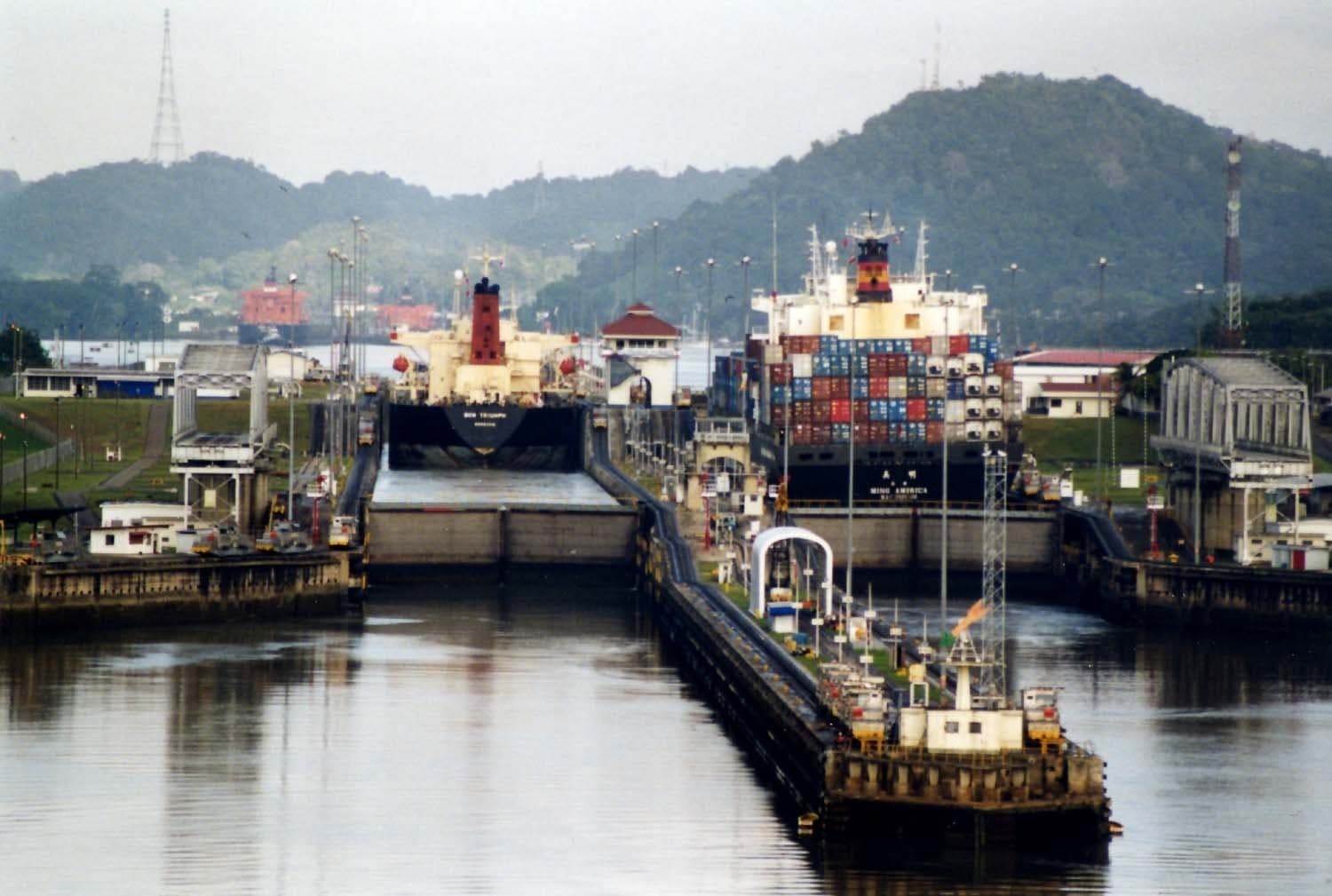
The Panama Canal is a bridge of water, and the water is rain. Each transit is lifted 26 metres over the continental divide by gravity, fed from the Gatun reservoir, and every lockful ends in the sea. In an ordinary year the watershed refills faster than the locks drain it. In 2023 a strong El Nino cut the rains across Central America, Gatun fell to 79.6 feet in August against a normal operating range in the mid-80s, and the canal authority began rationing the one input it cannot buy1.
The rationing was drastic. From 36 to 38 daily transits in July 2023, capacity was cut in steps to 25 at the end of October and 18 by February 2024, with maximum drafts squeezed below 44 feet, forcing container ships to sail light or not at all12. Queues formed at both entrances; carriers weighed weeks at anchor against ten thousand extra kilometres around Cape Horn or through Suez, itself about to have problems of a different kind. The spot market for priority found its price on 8 November 2023, when Japan's Eneos Group paid $3.975 million at auction, on top of ordinary tolls, to jump one gas carrier up the line2.
Daily Panama Canal transits, July 2023 to February 2024, as Gatun's water ran short. One November auction slot went for nearly $4 million.
What the drought cost, and taught
The macro damage stayed smaller than the headlines implied, because trade reroutes before it stops. Grain moved to rail bridges and around capes; gas carriers, the biggest auction payers, priced the detour and split the difference. The lesson the episode actually taught is narrower and more useful: the canal's binding constraint is not lock size, which the 2016 expansion fixed, but fresh water, which it did not touch. The Neopanamax locks that doubled capacity also drink more per cycle, and they were designed against twentieth-century rainfall statistics that the twenty-first century is busy revising4.
Timing compounded the pain. The drought's worst months overlapped with the Red Sea attacks that pushed much of Asia-Europe shipping around the Cape of Good Hope, so both of the world's great shortcuts degraded in the same season, and the fuel burned on the resulting detours was large enough to show up in global bunker demand, which rose 4% in 2024 substantially on rerouting4. Shippers discovered that their two chokepoint insurances were correlated: one fails on rainfall, the other on politics, and a planning department now has to price the year both fail together, because that year has already happened.
The cargo mix explains who paid most. Container lines hold long-term booking priority and mostly kept moving, lighter and dearer. The auction victims were the flexible arrivals: gas carriers hauling US propane and LNG to Asia, grain ships, tankers. For American Gulf exporters the canal is the difference between the short Pacific route and an extra ocean, which is why the record bidders were energy traders and why US export economics feel Gatun's water level before most Panamanians do.
Climate research since has sharpened the point rather than softened it. Analyses of the 2023-24 event attribute the shortfall primarily to El Nino's rainfall deficit landing on a watershed already stressed by rising demand for transits and for Panama City's drinking water, which draws on the same lakes. Warming loads the dice toward both deeper droughts and heavier extremes: the same infrastructure spent early 2024 rationing water and late 2024 opening spillways to dump it4. Variance, not the average, is what a reservoir has to be sized for.
The recovery was fast, and complete on paper
La Nina refilled the lakes through 2024; by August Gatun was back near 85 feet, drafts returned to the full 50 feet, and the schedule returned to its design tempo of about 36 daily slots3. The books recovered faster than the traffic: fiscal 2025 closed with 13,404 transits and revenue up 14.4% to $5.7 billion3, because the tolls and surcharges repriced during the shortage did not all reprice back. Scarcity taught the canal what its passage is worth, and monopolies remember.
Transit counts, though, remain below the pre-drought peak even with water to spare3. Some cargo that learned the alternatives kept them: US Gulf gas exporters signed for capacity around the Cape of Good Hope, transpacific services consolidated onto bigger ships making fewer calls, and the canal's customers now hold the routing option they were forced to price in 2023. A chokepoint that fails once never gets all of its captive traffic back.
Measure | Drought trough | Recovered |
|---|---|---|
Daily transits | 18 (February 2024) | About 36 |
Maximum draft | Below 44 feet | 50 feet |
Gatun level | 79.6 feet (August 2023) | Near 85 feet (August 2024) |
Priority slot at auction | Up to $3.975 million | Ordinary booking fees |
Annual revenue | Squeezed volumes | $5.7 billion in FY2025, up 14.4% |
Buying a second watershed
The structural answer was approved while the memory was fresh: the Rio Indio reservoir, a dam on the neighbouring river basin connected to Gatun by tunnel, designed to add water for roughly 11 to 13 additional daily transits in a drought year5. It is the canal's first new water source in a century, its budget runs over a billion dollars, and it requires relocating communities in the valley, which is why the consultation has moved slowly and why the authority pairs the project with payments and land programs. The engineering is conventional. The politics of taking a valley to insure a trade route are not, and they are the project's actual critical path.
Between droughts, the authority has industrialised water discipline: cross-filling between lock chambers, water-saving basins on the new locks used more aggressively, recycling a portion of each lockage, and slot allocation redesigned so that the water each transit consumes is priced into it. The drought converted water from a free input into the canal's unit of account.
The episode's larger meaning sits in a category the shipping industry had not priced before: climate volatility repricing a trade artery in real time. Canals have closed for wars and collisions; 2023-24 was the first time a major artery throttled itself for months on weather, published the shortage daily, and auctioned the residual capacity. Every infrastructure operator with a watershed, a river draft, or a cooling-water intake watched the mechanism work: scarcity arrives gradually, gets a price quickly, and leaves a permanent risk premium behind. The canal was the demonstration project for a repricing that has barely started elsewhere.
The competitive map is why the authority moved fast rather than waiting out the cycle. The canal's rivals are not other canals; they are the US intermodal rail bridge, which carried the diverted grain and can keep any cargo it wins the pricing argument for, and the all-water Suez routing for Asia-to-US-East-Coast strings, which returns to competitiveness whenever the Red Sea does. A monopoly on a route is not a monopoly on the trade, and the drought published, in weekly detail, exactly how much of the canal's traffic was preference rather than necessity.
The geopolitical echo
Scarcity also invited attention. The canal spent 2025 in headlines for non-hydrological reasons: an American administration pressing claims about Chinese influence over the waterway, a contested deal to move the Hong Kong-based operator of two adjacent ports into American-led ownership, and Panamanian politics absorbing both. None of that changes the physics of Gatun, but it changes the stakes of every future closure: a canal that rationed neutral passage on hydrology once will find its next rationing read as policy, whatever the rain gauges say.
What to watch
The ENSO cycle first: forecasts of the next El Nino are now market information for every carrier with transpacific strings, and the canal publishes its lake levels like a central bank publishes reserves4. Second, the Rio Indio timeline, permits, resettlement, then years of construction, because until it fills, the canal rides each wet season with no spare tank. And third, the toll-and-auction structure in the next shortage: 2023 established that priority at Panama is worth millions to the right ship on the right day, and the authority now knows it. The water will run short again. The question the drought answered is what the canal does about it; the question it opened is what the canal charges for it. For Panama, whose treasury takes the canal's dividend, the difference between those answers is a fiscal line; for everyone whose cargo crosses the isthmus, it is a standing line item that did not exist before an August afternoon in 2023 when the lake gauge read 79.6 feet.
Woodwell Climate Research Center, Drought, climate, and the Panama Canal, and project44, Recovery of the Panama Canal: Gatun at 79.6 feet in August 2023; transits from 36-38 in July 2023 to 18 by February 2024; drafts below 44 feet.
The Maritime Executive, Panama Canal auction sets record $4M for slot, and gCaptain, LPG tanker pays record $4 million for Panama Canal slot (November 2023): Eneos Group's $3.975 million bid of 8 November 2023; capacity steps of 25 slots from late October and 18 from 1 February 2024.
Kuehne+Nagel, Panama Canal has plenty of water but transits still below pre-drought levels (July 2025), and Rio Times, The Panama Canal bounced back from drought: Gatun near 85 feet by August 2024; return to about 36 daily transits and 50-foot drafts; FY2025 revenue up 14.4% to $5.7 billion on 13,404 transits.
Munoz et al., Drying of the Panama Canal in a warming climate, Geophysical Research Letters (2025), and gCaptain, Panama Canal opens spillways as reservoir hits maximum level and El Nino watch puts Panama Canal back in focus.
gCaptain / Yahoo News, Panama Canal board approves plans for new reservoir to combat drought: Rio Indio reservoir designed to support an additional 11 to 13 daily transits in drought conditions.