The devices this sentence reaches you on, the data centres that route it, the cars in the street outside, and the weapons that deter or do not deter their theft all depend on logic chips from the leading few nanometres of semiconductor manufacturing. In 2025, one company made most of them. Taiwan Semiconductor Manufacturing Company took a record 70.2% of global foundry revenue in the second quarter, its highest share ever, and held about 70% for the year1.
The aggregate understates it. Only three companies in the world can manufacture at 7 nanometres or below: TSMC, Samsung, and Intel, and TSMC has the dominant yields and nearly all of the customers who matter1. Apple's phone processors, Nvidia's AI accelerators, AMD's CPUs, Qualcomm's modems: different logos, same fabs. At the newest node, the concentration is contractual fact: 2-nanometre production entered high volume in the fourth quarter of 2025, reached roughly 90,000 to 100,000 wafers a month by early 2026, and is fully booked through 20281.
TSMC's share of global foundry revenue in Q2 2025, a record. At nodes below 7 nanometres its position is stronger still.
The frontier became the whole business
TSMC's own revenue mix shows where the world's demand went. Advanced nodes, 7 nanometres and below, produced 74% of its 2025 wafer revenue: 36% from 5-nanometre-class production, 24% from 3-nanometre, 14% from 7-nanometre2. A decade ago the leading edge was a prestige business subsidised by long tails of mature production. Now the tail is the sideline and the frontier is the company. Across the whole industry, nodes at 7 nanometres and below generated over 56% of 2025 foundry revenue1, and effectively all of that production happens on Taiwanese soil or in fabs TSMC operates abroad.
Process generation | Share of wafer revenue |
|---|---|
5-nanometre class | 36% |
3-nanometre class | 24% |
7-nanometre class | 14% |
All mature nodes combined | 26% |
The economics that produced this are a ratchet. Each node costs more to develop and equip than the last; each therefore needs more volume to pay back; the customers with that volume go to the fab with the best yields, which funds the next node first. Samsung and Intel have not left the race, and both won US subsidies to stay in it, and each new node they trail at widens the yield gap they trail by. The economics create powerful concentration, and each generation compounds it.
Why it happened on Taiwan
Nothing about silicon requires an island on a seismic fault 130 kilometres from a state that claims it. TSMC's founding insight in 1987 was organisational: a foundry that manufactures for everyone and competes with no customer. Once that model won, the concentration compounded through people and proximity: three shifts of process engineers, supplier parks around each fab, universities feeding the pipeline, and a national government that treats the company as strategic infrastructure. The machines can be bought, at least by those allowed to buy them; the accumulated operating knowledge of running them at economic yield cannot, and that knowledge lives overwhelmingly in Hsinchu, Taichung, and Tainan.
One dependency sits behind the dependency. Every leading-edge fab, TSMC's included, patterns its finest layers with extreme ultraviolet lithography machines made by exactly one company, ASML of the Netherlands. The chip supply chain does not narrow to a single point; it narrows to a chain of single points, of which the island is the widest.
The customers have no second source
The textbook answer to a dominant supplier is to qualify another one. At the leading edge the textbook fails on physics and time. Porting a flagship chip between foundries means redesigning it for a different process, a year or more of engineering with no revenue attached, to reach a fab whose yields on that design are unproven. So Apple has shipped every flagship processor for a decade from TSMC lines, Nvidia's AI accelerators, the most supply-constrained product on earth through the boom, come from TSMC wafers and TSMC packaging, and both companies' contingency plans are better described as prayers with purchase orders attached.
The would-be second sources are trying to buy their way back to the table. Intel has bet its future on regaining process leadership and opening its fabs to outside customers, with Washington's subsidies and, since 2025, an unprecedented direct federal equity stake behind it. Samsung builds in Texas as well as Korea. Both still trail on yield at the nodes that matter, and every quarter they trail, the booked-through-2028 order book at their competitor grows another quarter longer1. Duopoly bids may return to the leading edge; nobody's roadmap dates it before the late 2020s.
The Arizona hedge
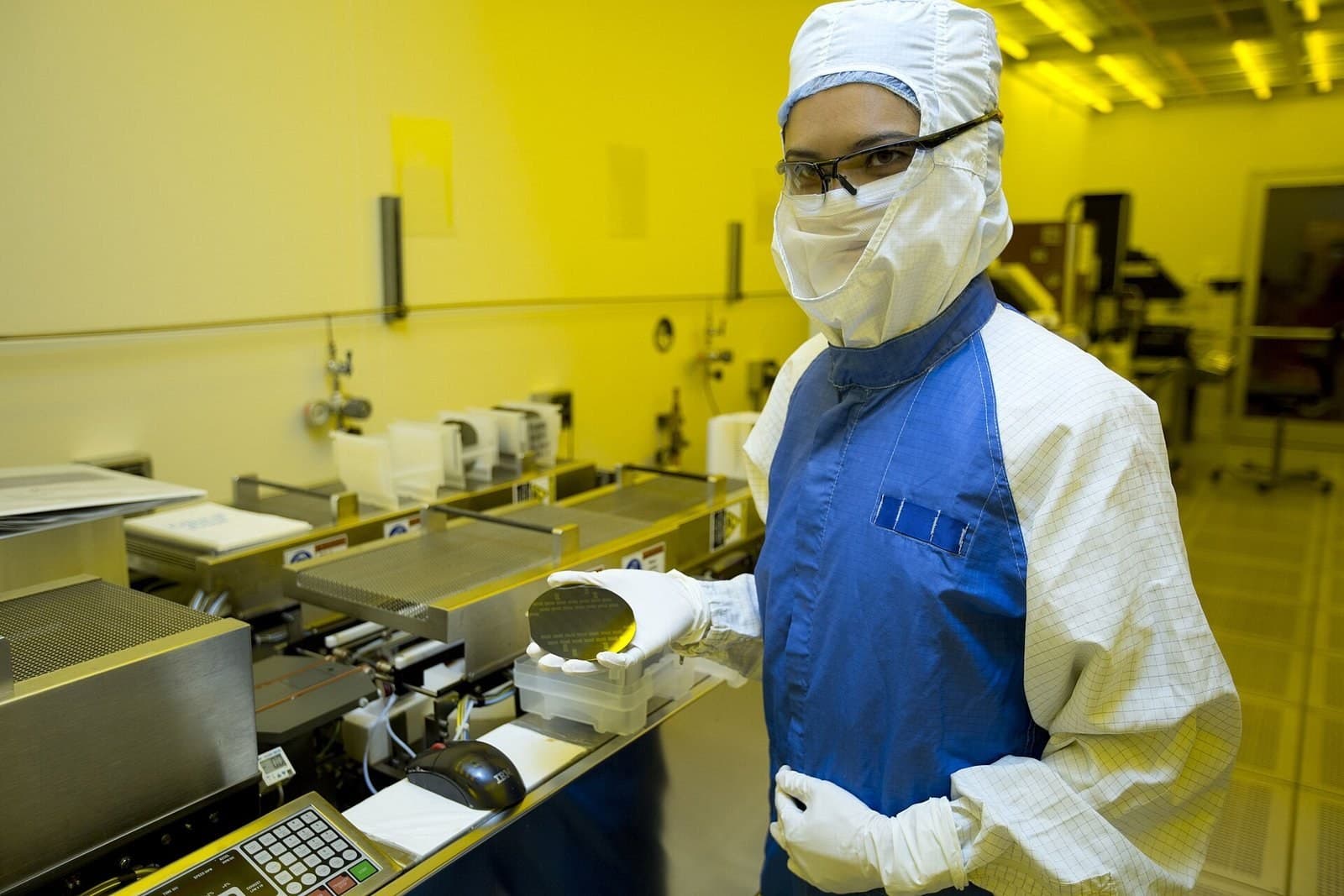
The concentration is now official policy concern on three continents, and the most concrete response is in Phoenix. TSMC's Arizona site has grown into a committed $165 billion program: three fabs with more planned, advanced packaging facilities, and an R&D centre3. The first fab entered high-volume production on the N4 process in the fourth quarter of 2024 and ships real products, Apple and AMD processors among them, with yields reported on par with Taiwan4. The second fab, built for 3-nanometre, targets production in 2027; the third is designated for 2-nanometre and the A16 generation, and ground has broken on a fourth and on the first packaging plant3.
The arithmetic keeps the hedge in proportion. Arizona's output is a small fraction of TSMC's total, the newest node arrives there roughly two years after Taiwan, and until the packaging plants open, wafers made in Phoenix still cross the Pacific to be assembled. What Arizona buys is not independence from Taiwan; it is a proof that the operating knowledge can be transplanted at all, at a price only one customer nation could underwrite, on a timeline measured in decades.
The buyer who is locked out
One major economy is barred from the front of this queue. Since October 2022 US export controls have blocked sales of the most advanced chips and the tools to make them to China, with the restrictions tightened repeatedly since and the Netherlands and Japan pulled into alignment on lithography. China's response has run in both directions at once: SMIC, its champion foundry, has pushed to 7-nanometre-class production without EUV machines, at yields and costs nobody outside the company can audit, while Beijing has answered with export controls of its own on gallium, germanium, and rare earths, the inputs it does dominate. The island at the centre of this piece is therefore not only a supply-chain concentration; it is the front line of the first full-scale industrial-policy war between great powers since the Cold War.
What the concentration costs
The risks are familiar and real: earthquakes, drought years that ration the water fabs drink in millions of litres, energy dependence on imported LNG, and the standing possibility of blockade or war, against which no inventory buffer is meaningful because advanced chips are consumed by the billion. Less discussed is the peacetime cost. A sold-out monopoly node prices like one: 2-nanometre wafers booked through 2028 are wafers whose buyers had no alternative quote to bring to the table1. The AI build-out's capital costs are, in part, a concentration premium being paid to one supplier's margins.
The mitigation map now has three pins outside Taiwan and the United States. TSMC's joint-venture fab in Kumamoto, Japan, opened in 2024 and makes mature-node chips for the automotive and image-sensor customers clustered around it; a second Japanese fab is planned, and a Dresden joint venture is under construction to serve European carmakers on similar nodes. These plants diversify geography for the chips that go into cars and sensors, which is worth having, and they do not touch the frontier: every wafer of the newest generation is made in Taiwan until Arizona's later fabs come online, which is the gap all this construction is racing to narrow.
Taiwan's government calls the industry its silicon shield, the argument that indispensability deters attack because nobody benefits from breaking the thing everyone needs. The argument cuts both ways, and the diversification now under way in Arizona, Japan, and Germany is every major buyer acting on the second reading.
What to watch
Three markers through 2027. Whether the Arizona second fab hits its 2027 date for 3-nanometre, because schedule is the test of whether transplantation scales3. Whether Samsung or Intel lands a flagship external customer at 2 nanometres, because one defection would mark the first real price competition at the edge in years. And the share of TSMC revenue produced outside Taiwan, the single number that measures whether the world's most concentrated dependency is actually loosening or merely franchising. On current plans that share rises through the decade and stays a minority of the total, with the newest node always arriving on the island first. The map in 2030 has more factories on it than the map in 2020. It has the same centre.
Silicon Canals, Advanced chips of 7 nanometers and beyond made up 74% of TSMC's wafer revenue in 2025: 5nm 36%, 3nm 24%, 7nm 14% of 2025 wafer revenue.
TSMC, TSMC Arizona and TSMC Announces Updates for TSMC Arizona: $165 billion committed; N4 high-volume production from Q4 2024; second fab targeting 3nm production in 2027; third fab designated 2nm and A16; construction started on a fourth fab and the first advanced packaging facility in early 2026.
Arizona Technology Council, TSMC Arizona Fab 21 is already making 4nm chips, yield on par with Taiwan: Apple A16 and watch processors and AMD Ryzen 9000 CPUs in production.