The world spent $2,887 billion on its militaries in 2025, a 2.9% real increase, the eleventh consecutive annual rise, and the highest figure in SIPRI's records1. The military burden, spending as a share of world GDP, ticked up to 2.5%; per person alive, the year's bill was $3521. A decade of this compounding, 41% growth since 2016, has quietly ended the post-Cold War assumption that defence was a shrinking claim on rich economies. Rearmament is no longer a forecast. It is a budget line, in force, nearly everywhere.
Nearly, because the table's most surprising row is its largest. United States spending fell 7.5% in 2025, to $954 billion1, the first meaningful decline of the era on SIPRI's real-terms accounting, even as Washington demanded more from everyone else. A fall in the SIPRI series measures budgets, not commitment, but it is the same yardstick every other government is measured by. World spending excluding the US grew 9.2%1. The global rearmament and the American retrenchment are the same story: the alliance leader is converting its security guarantee into a burden-shifting negotiation, and the burden is visibly shifting.
World military expenditure in 2025, an 11th consecutive record. US spending fell 7.5%; the world excluding the US rose 9.2%.
Europe pays the invoice it deferred
Europe is where the decade turned. The continent's spending rose 14% in 2025 to $864 billion, after the 2024 surge that SIPRI called the steepest since the Cold War's end12. Germany is the emblem: up 24% in one year to $114 billion, up 118% over the decade, now the world's fourth spender and Europe's first, a sentence that would have been unprintable in 20151. Poland, the Nordics, and the Baltics run harder still relative to size, and Ukraine, the war's centre of gravity, spent an estimated $84.1 billion, 40% of its entire GDP, on a defence budget that has grown fifteen-fold in a decade1.
The alliance arithmetic was formalised at The Hague in June 2025, when all NATO members except an exempted Spain committed to reach 5% of GDP by 2035: 3.5% on core defence, 1.5% on a broader basket of infrastructure, cyber, and Ukraine assistance, with a progress review set for 20293. NATO's 32 members already account for $1,581 billion, 55% of world spending, with European members at $559 billion and 23 of 32 past the old 2% line1. The 5% pledge, if honoured, implies European defence budgets roughly doubling again, which is why every finance ministry on the continent has spent the months since inventing accounting categories and the phrase 'defence-related investment'.
Spender | 2025 spending | Change |
|---|---|---|
United States | $954 billion | -7.5% |
China | $336 billion (est.) | +7.4%; +62% over the decade |
Russia | $190 billion (est.), 7.5% of GDP | +5.9% |
Germany | $114 billion | +24%; +118% over the decade |
India | $92.1 billion | +8.9% |
Ukraine | $84.1 billion, 40% of GDP | +20% |
Europe, total | $864 billion | +14% |
NATO, 32 members | $1,581 billion | 55% of the world total |
The 5% number needs scepticism, applied evenly. On SIPRI's methodology only a handful of members approach the core 3.5% today, and the 1.5% 'defence-related' basket is elastic enough to absorb bridges, broadband, and border posts that would have been built anyway; the target's designers understood that a pledge audited in 2029 by whoever then governs thirty-two democracies is a direction, not a contract3. What is not elastic is the direction itself. Even discounted for creative accounting, the trajectory of European core budgets since 2022 is the steepest sustained rearmament by democracies since the 1930s, and unlike the pledges, the appropriations are law.
The fiscal mechanics matter as much as the totals, because they decide who feels it. Germany suspended its constitutional debt brake for defence, converting rearmament into borrowing rather than taxation; Poland leans on off-budget funds and US credit; the EU is assembling joint instruments that would have been federal heresy a decade ago. Borrowed rearmament defers the guns-versus-butter collision rather than cancelling it, and Europe's ageing electorates will be voting on pension-versus-Patriot trade-offs for the rest of the pledge's life.
The other theatres
Asia's line compounds more quietly and may matter more. China's estimated $336 billion marks three decades of uninterrupted increases, 62% growth over this one, funding the naval build-out and missile forces that set the Pacific's planning assumptions; Japan's 9.7% rise continues the most consequential defence normalisation in Asia; India spends $92 billion watching two borders1. Regional spending rose 8.1% to $681 billion1. Unlike Europe's surge, none of this is a response to an ongoing war. It is the price of one being considered possible.
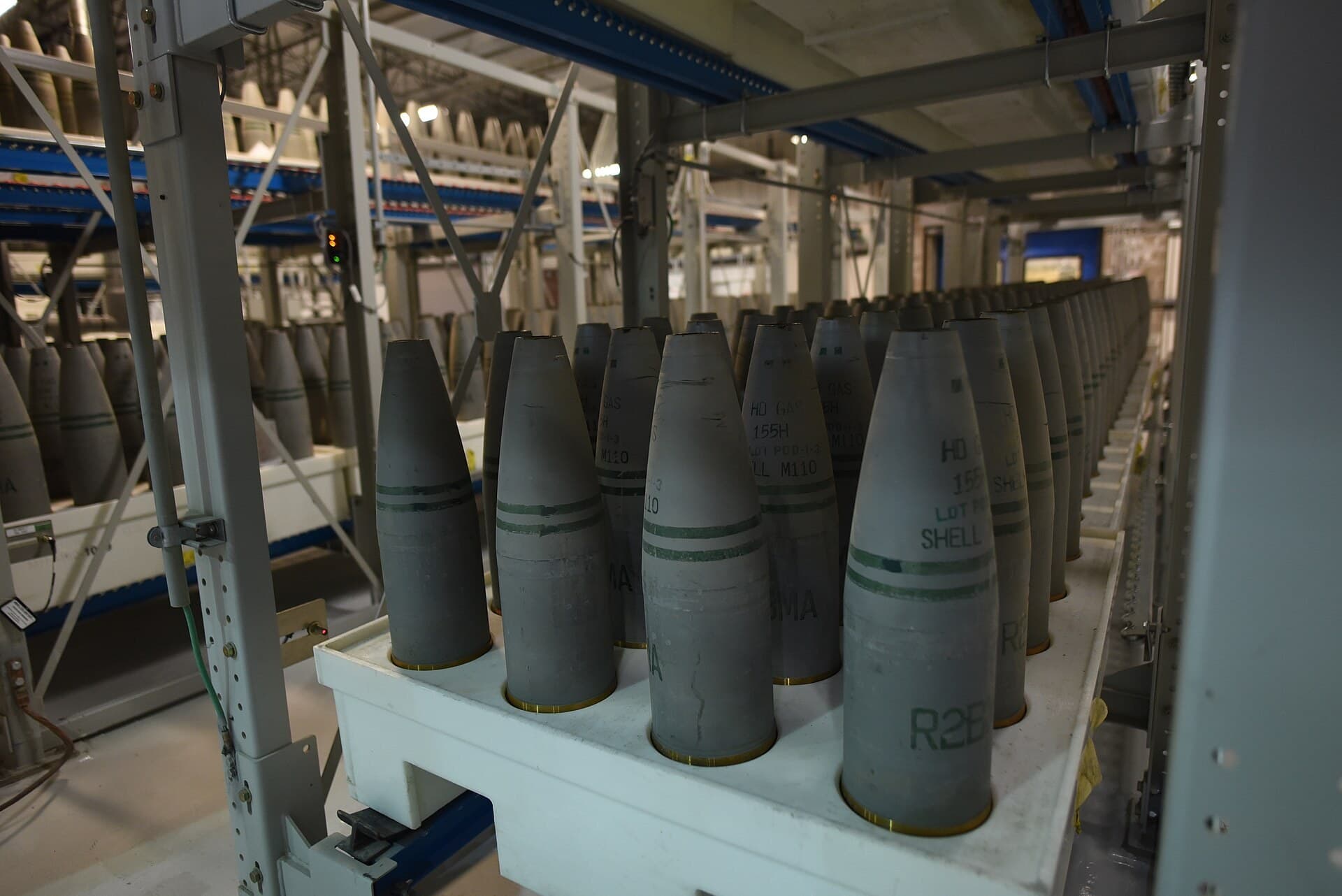
Russia, the war's author, is estimated at $190 billion, 5.9% up on the year and 7.5% of GDP, a war economy sustained by fiscal improvisation and import substitution1. The comparison with Europe's $864 billion states the paradox of the moment: the continent outspends its threat nearly five to one and still scrambles, because stocks, production lines, and manpower, not annual flows, are what deter, and Europe spent thirty years converting its defence industry to boutique production of exquisite systems. The money now arriving must first rebuild the capacity to spend itself usefully, which is why artillery-shell counts became household statistics.
The Middle East and Africa fill out the map with their own logics. Gulf budgets remain among the world's heaviest relative to GDP, Saudi Arabia's $83 billion at 6.5%1, buying both hardware and the industrial offsets that anchor Western primes to the region; the war economies of the Horn and the Sahel spend less in dollars and more in consequence, where an armoured battalion's budget is a health ministry's. The 2025 table's quietest fact is that military spending rose in every region except the Americas1: whatever the great-power story, the world's median government has read the decade as an argument for arming, whatever its neighbours conclude in reply.
Ukraine's row rewards a second look, because it is the table's argument about what all the other rows are for. Forty per cent of GDP is not a defence budget; it is a society liquidated annually into its own survival, sustained by allied finance that shows up in other countries' 1.5% baskets13. Every European planning document since 2022 is an attempt to ensure no member state ever occupies that row, and the cheapest insurance yet discovered, unfashionable as it reads, is the deterrence the rest of the table is buying.
What the money crowds
A military burden moving from 2.4% to 2.5% of world GDP sounds marginal and compounds enormously: against the $2.5 trillion tariff decade, the $13 billion fusion bet, or the entire $685 billion global remittance flow, the world's armies now claim more than any of them, every year, before a shot. The opportunity cost lands unevenly: for Germany the 24% rise is a political revolution financed by a constitutional debt amendment; for Ukraine, 40% of GDP is national survival as fiscal policy; for the poorest states in the data, every point of GDP under arms is subtracted from development budgets. Guns against butter is the oldest trade in economics, and in 2025 the terms moved for the eleventh consecutive year1.
The industrial consequence is a boom with a decade of order books. European and American primes carry backlogs into the 2030s, munitions capacity is being tripled on both sides of the Atlantic, and the defence-industrial labour shortage now competes with the chip fabs and the grid build-out for the same welders and engineers. Security of supply arguments have also reached defence's inputs, from Chinese gallium in radar sets to rare earths in magnets, folding the rearmament into the same materials chokepoints as everything else.
One methodological note keeps the whole table honest. SIPRI's China and Russia figures are estimates, bracketed in the source data, because both states publish budgets that exclude much of what they spend; purchasing-power arguments would lift China's effective total far above the dollar figure, since a conscript and a shipyard hour cost less in Shanghai than San Diego. The dollar table understates the capability shift toward Asia, in other words, and every serious planning staff adjusts for it. The public numbers are the floor of the story, not its ceiling1.
What to watch
Four lines through 2029, the Hague pledge's review year3. Whether US spending's 2025 decline is a blip or the start of the handover it implies, because everyone else's plans price the answer. The gap between NATO pledges and appropriations, measured not in communiques but in the 3.5% core line3. China's estimate against its Pacific timetable, the number with the largest war-and-peace variance attached1. And Europe's shell-and-platform output against its budgets, because the decade's test is not whether the money is spent, it now demonstrably is, but whether spending converts to deterrence before it is asked to convert to something worse. The eleventh record year is on the books. The wager underneath all $2,887 billion of it is that the twelfth, and the twentieth, are purchased peace rather than instalments on a war, and that wager is the one line no fact sheet, this one included, can audit in advance.
SIPRI, Trends in World Military Expenditure, 2025 (April 2026): $2,887 billion, up 2.9%, 11th consecutive rise, 2.5% of world GDP, $352 per person; US $954 billion (-7.5%); China $336 billion (+7.4%, +62% over 2016-25); Russia $190 billion (7.5% of GDP); Germany $114 billion (+24%, +118%); India $92.1 billion; Ukraine $84.1 billion (40% of GDP); Europe $864 billion (+14%); Asia and Oceania $681 billion (+8.1%); NATO $1,581 billion, 55% of world; world ex-US +9.2%.
SIPRI, Unprecedented rise in global military expenditure (April 2025): 2024's rise the steepest since at least the end of the Cold War.
NATO, The Hague Summit Declaration (25 June 2025), and NATO, Defence investment and the 5% commitment: 5% of GDP by 2035, split 3.5% core defence and 1.5% broader security investment; Spain exempted; review in 2029.